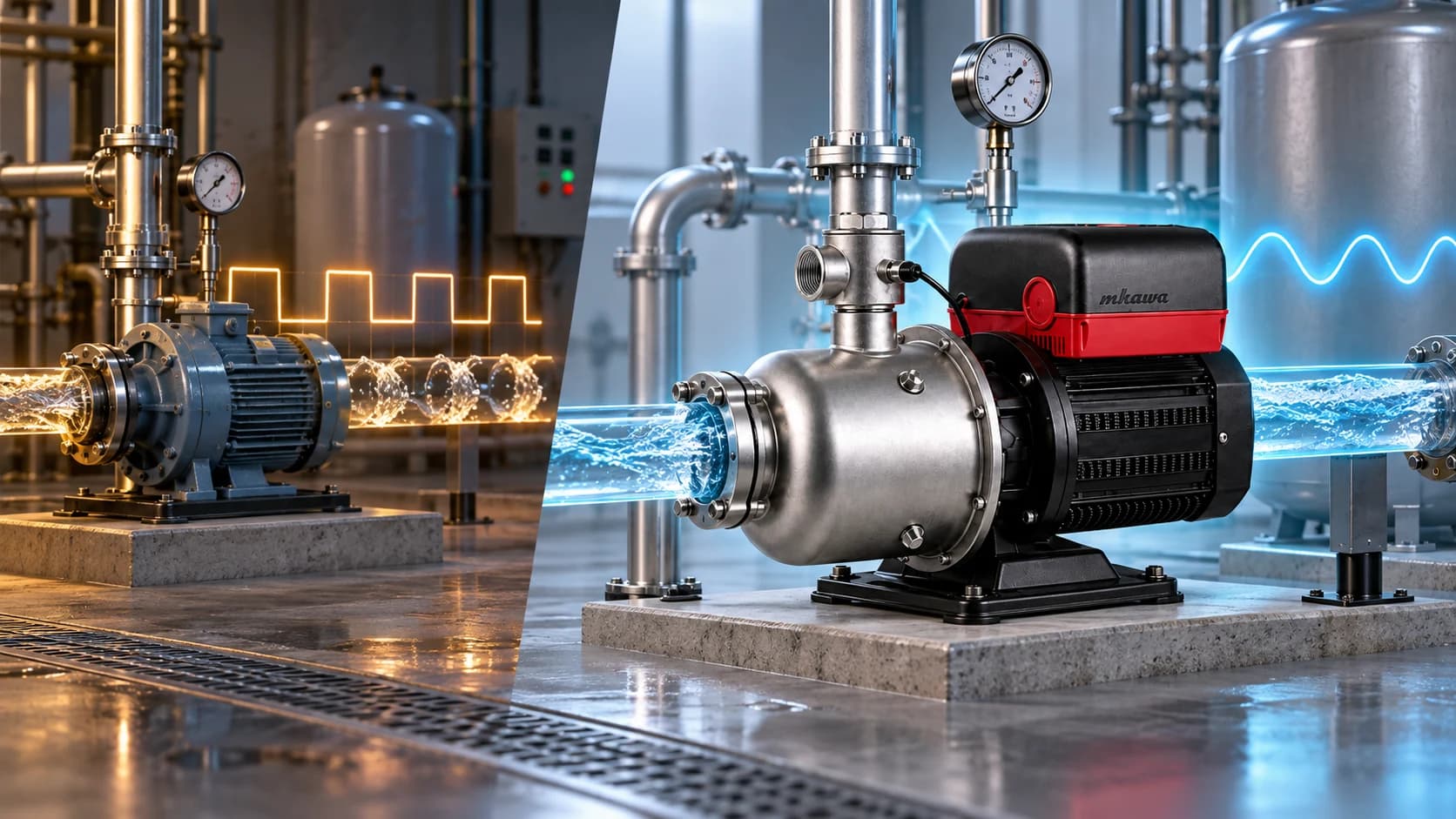

VFD Pump vs Fixed-Speed Pump: Which Uses Less Power?
Mkawa Engineering India
Technical Division
The short answer
A VFD pump usually has the stronger energy-saving opportunity when flow or pressure demand varies. A correctly sized fixed-speed pump can remain sensible when the duty is steady and the pump runs near its best-efficiency region.
A variable frequency drive changes the frequency and voltage supplied to the motor, allowing pump speed to follow system demand. A fixed-speed pump runs at one nominal speed and typically uses cycling, throttling, bypassing or a pressure vessel to manage demand.
Side-by-side comparison
| Question | Fixed-speed pump | VFD pump |
|---|---|---|
| Speed | One nominal speed | Adjusts within programmed limits |
| Variable demand | Often cycles or throttles | Modulates to a pressure or flow setpoint |
| Pressure comfort | Can fluctuate between control points | Can maintain a steadier setpoint when sized correctly |
| Starting | Direct or starter-dependent | Controlled ramp-up is typical |
| Electronics | Simpler | Drive, sensor and programming required |
| Best fit | Stable duty, limited run time | Variable duty, longer run time, pressure-critical use |
Why reducing speed can reduce power
For a centrifugal pump operating under similar conditions, the affinity laws provide useful first estimates:
- Flow is approximately proportional to speed
- Head is approximately proportional to speed squared
- Power is approximately proportional to speed cubed
This relationship explains why speed control is often more efficient than creating excess pressure and wasting it across a valve. Actual savings must be calculated against the system curve and include motor and drive efficiency.
When a VFD is a strong fit
- Several taps or zones open and close throughout the day
- A building needs stable pressure across changing demand
- A hot-water or HVAC loop operates for long hours
- An existing system throttles substantial excess pressure
- Soft starting and reduced hydraulic shock are priorities
When fixed speed may be enough
- The required flow and head are genuinely constant
- Operating hours are very low
- A simple transfer duty fills a tank and then stops
- The environment is unsuitable for electronics without additional protection
Do not forget commissioning
A VFD does not save energy merely because it is installed. The pressure setpoint, minimum speed, sleep mode, sensor location and acceleration settings need to match the system. Setting pressure higher than users need can erase a meaningful portion of the benefit.
List the required flow and head at low, normal and peak demand, then compare annual input energy for both options. The U.S. Department of Energy provides pump-system assessment resources.
Ask Mkawa to review your duty cycle or compare intelligent constant-pressure pumps.
Tags
RELATED PRODUCTS
Need the Right Pump for Your Project
Share your duty point, operating hours and site conditions. Our engineering team will help identify a suitable permanent-magnet or variable-speed pumping solution.
Q + H
Duty Point
kWh
Energy View
VFD
Control Review
TCO
Lifecycle View