
Best Pressure Pumps for High-Rise Buildings in India (2026)
Mkawa Engineering India
Technical Division
The High-Rise Water Pressure Problem
India is building upward. With urbanization accelerating, high-rise apartments (10+ floors) are becoming the norm in Bangalore, Mumbai, Hyderabad, Pune, and Delhi NCR. But taller buildings create a fundamental engineering challenge: getting water to the top floors at adequate pressure.
Available municipal pressure varies by location and time of day and should be measured at the site. A high-rise design must account for elevation, residual outlet pressure, pipe losses, zoning, and simultaneous demand. Without a properly engineered system, residents on upper floors can experience:
- Weak shower pressure
- Geysers and washing machines failing to operate
- Uneven water distribution between floors
- Complete water outage during peak hours
Understanding the Engineering Requirements
Pressure Calculation
The basic formula for high-rise water pressure:
Required Head = Building Height (m) + Friction Losses + Desired Outlet Pressure
For a 15-storey building (45 metres):
- Building height: 45 m
- Friction losses (piping): ~15 m
- Desired outlet pressure: ~15 m (1.5 bar)
- Total required head: ~75 metres
Flow Rate Calculation
Flow rate depends on fixture loading, occupancy, storage strategy, and simultaneous usage. The ranges below are only early-stage examples, not design values:
| Building Size | Units | Peak Flow Rate |
|---|---|---|
| 10 floors, 2 units/floor | 20 units | 150–200 LPM |
| 15 floors, 4 units/floor | 60 units | 400–600 LPM |
| 20 floors, 4 units/floor | 80 units | 600–900 LPM |
Pumping System Architectures
1. Direct Boosting (Small Buildings, up to 10 floors)
A single booster pump set draws water from a ground-level tank and pushes it directly to all floors.
Best for: Smaller apartment complexes, commercial buildings up to G+10
Selection note: compare the calculated duty point with the complete pump curve and retain an engineering margin. No model should be selected from floor count alone.
2. Zone-Based Boosting (Medium Buildings, 10–20 floors)
The building is divided into pressure zones (e.g., floors 1–10, floors 11–20), each served by a dedicated pump system. This prevents over-pressurization on lower floors.
Best for: Mid-rise residential towers, hospitals, hotels
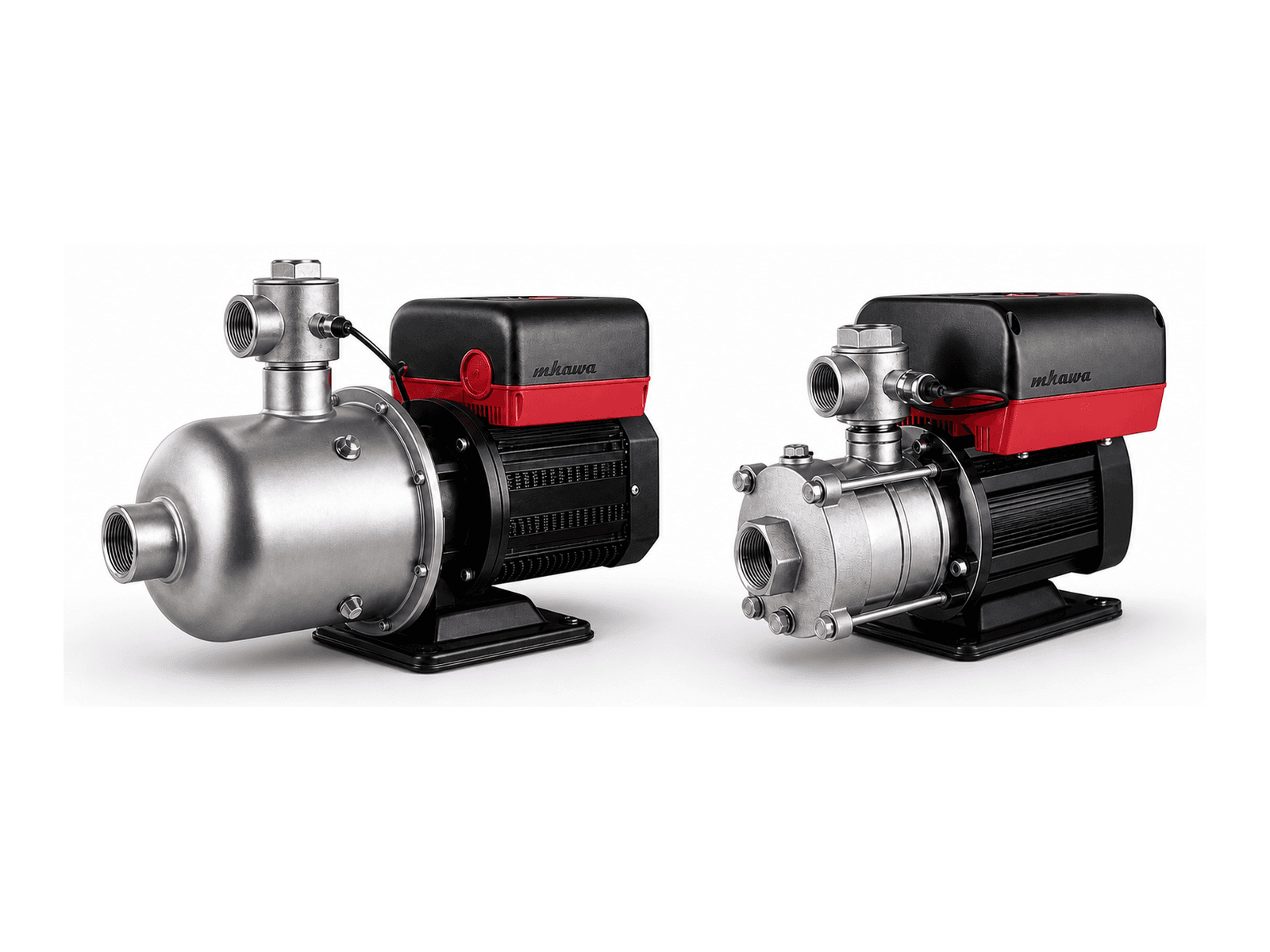
Selection note: each zone needs its own flow, head, pressure-rating, and control assessment. The SCA504 and SCA604 supplied brochures list maximum heads of 45 m and 53 m respectively; they are not described as multi-stage high-rise systems.
3. Hydropneumatic Systems (Large Buildings, 20+ floors)
Pumps work with pressurized vessels to maintain constant system pressure. Variable-speed drives adjust pump output based on real-time demand.
Best for: Premium high-rises, commercial towers, mixed-use developments
Selection note: cascade operation, redundancy, vessels, and sensors must be specified as a designed system. The supplied WHB/WHBJL brochure describes individual pump models and does not document built-in cascade control.
Key Features for High-Rise Applications
1. Redundancy (Dual Pump Systems)
A single pump failure can interrupt water service, so critical installations often use dual-pump or multi-pump arrangements. Depending on the control panel, these may provide:
- Lead/Lag operation — pumps alternate to equalize wear
- Automatic failover — if one pump fails, the other takes over instantly
- Maintenance mode — one pump can be serviced while the other runs
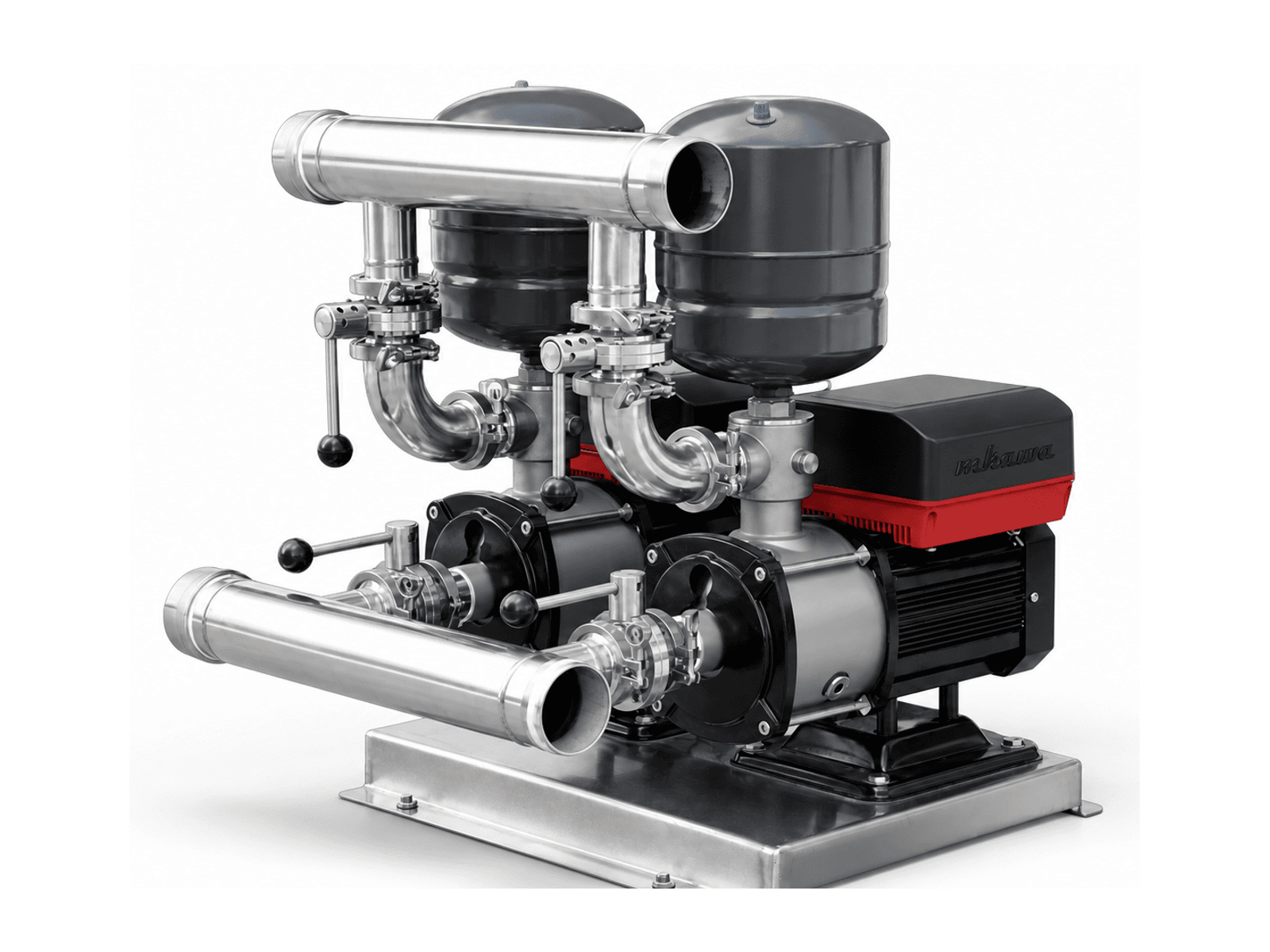
The supplied BHM SET brochures show twin-pump assemblies. Confirm sequencing, alternation, and failover functions in the project control-panel specification; those functions are not stated in the supplied brochures.
2. Variable Frequency Drive
VFD control can help regulate pressure under changing demand and ramp pump speed. It does not replace correct zoning, surge analysis, pressure-rated pipework, or commissioning.
3. Stainless Steel Construction
High-rise pump rooms often deal with:
- Hard water (high TDS common in Indian cities)
- Continuous operation (24/7 in large buildings)
- High temperatures (pump rooms can exceed 40°C)
Material compatibility should be checked against the water analysis, temperature, pressure, and required service conditions. Confirm wetted-part materials for the exact model rather than assuming them for a whole series.
4. Monitoring and Alarms
If remote monitoring is required, specify the necessary communication interface, sensors, alarm outputs, and building-management-system protocol. The supplied product brochures do not document IoT, SMS, app, or predictive-maintenance functions.
Installation Best Practices
Pump Room Location
- Ground floor or basement with adequate ventilation
- Minimum 1 metre clearance around pump sets for maintenance access
- Anti-vibration mounting pads to prevent noise transmission
Piping Design
- Dedicated suction and delivery headers
- Non-return valves on each pump outlet
- Pressure gauges at pump outlet and building entry points
- Expansion vessels to absorb pressure surges
Electrical Requirements
- Dedicated power supply with automatic changeover to generator
- Individual MCBs for each pump
- Surge protection for VFD controllers
Lifecycle Cost Comparison
A defensible lifecycle comparison needs quoted equipment cost, measured or modelled duty-cycle energy, local tariff, planned maintenance, spares, downtime assumptions, and the study period. Generic rupee figures or lifespan claims are not reliable enough for project selection.
Brochure-Verified Limits to Start a Selection
| Product family | Highest brochure maximum head | Highest brochure maximum flow |
|---|---|---|
| BHM single-pump series | 80 m (BHM5-40) | 20 m³/h (BHM12-55) |
| BHM twin-pump SET series | 80 m (BHM5-40SET) | 40 m³/h (BHM12-55SET) |
| WHB / WHBJL series | 80 m (25WHBL5-40) | 18 m³/h (40WHBL12-40) |
| SCA504 / SCA604 | 53 m (SCA604) | 6 m³/h (SCA604) |
These are separate maximum endpoints, not guaranteed simultaneous duty points. Use the relevant performance curve and consult engineering for zoning, redundancy, and controls.
Conclusion
Choosing the right pumping system for a high-rise building is a critical engineering decision. Calculate each zone's duty, check the full curves, define redundancy and controls, then compare lifecycle cost using project-specific inputs.
Planning a high-rise project? Send the site and duty details for an engineering review and suitable system proposal.
Tags
RELATED PRODUCTS
Need the Right Pump for Your Project
Our engineering team will assess your requirements and recommend the perfect IE5 permanent magnet pumping solution — with free technical consultation.
19
Patents
50+
Countries
IE5
Motor Class
24h
Support