
Permanent-Magnet vs Induction Motor Pumps: A Practical Comparison
Mkawa Engineering India
Motor & Controls Team
Two proven motor technologies
Induction motors have powered pumps for decades. They are robust, widely serviced and available across a broad power range. Permanent-magnet synchronous motors, or PMSMs, are increasingly used where compact size, variable-speed control and high efficiency matter.
The right choice depends on the complete pumping duty—not a technology label alone.
How they create torque
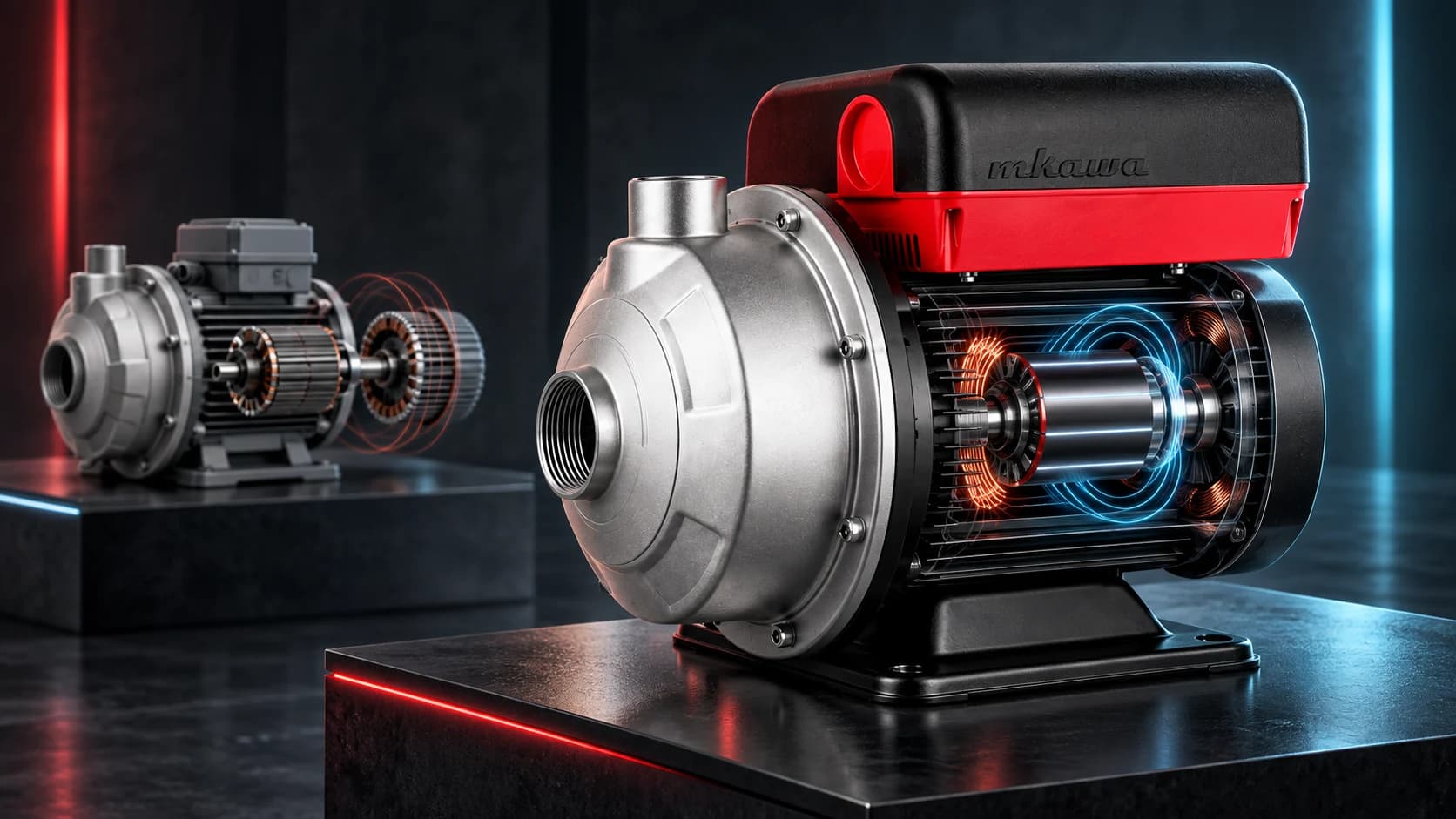
In an induction motor, current induced in the rotor produces the rotor magnetic field. The rotor must run slightly below the stator field's synchronous speed; this difference is called slip.
In a PMSM, permanent magnets provide the rotor field. The rotor follows the drive's rotating magnetic field synchronously. Avoiding rotor magnetising current can reduce losses, helping well-designed PMSMs reach high efficiency in compact packages.
Practical differences
| Feature | Induction motor | Permanent-magnet synchronous motor |
|---|---|---|
| Rotor field | Induced electrically | Created by permanent magnets |
| Slip | Required to produce torque | Synchronous with commanded field |
| Direct-on-line option | Common on suitable motors | Electronic control is normally required |
| Variable speed | Requires a compatible VFD | Requires a compatible electronic drive |
| Service familiarity | Very widespread | Controller and motor expertise matter |
| Selection proof | Pump curve and input-power data | Pump curve plus motor-drive input data |
Why part-load performance matters
Building demand rarely stays at one point. A pressure pump may see one tap at night and several fixtures in the morning. A circulation pump may run for thousands of hours away from peak load.
Compare efficiency and input power across the expected speed and torque range. A single full-load efficiency value cannot describe annual consumption for a variable-duty system.
Reliability and maintenance
Neither motor type is automatically maintenance-free. Bearings, seals, water quality, cooling, installation alignment and operation away from the intended pump range all affect service life.
PMSM systems also rely on their electronic controller. Check spare-parts support, fault history, environmental protection, sensor availability and commissioning capability—not only the motor efficiency number.
Which should you choose?
An induction motor remains a rational choice for many constant-duty and standardised industrial applications. A PMSM system is compelling when long operating hours, high efficiency, compactness and intelligent speed control justify the investment.
Always compare the same flow and head, electrical input power, the full duty cycle, drive compatibility, service support and total installed cost.
Explore Mkawa permanent-magnet pump systems or request a duty-point comparison.
Tags
RELATED PRODUCTS
Need the Right Pump for Your Project
Share your duty point, operating hours and site conditions. Our engineering team will help identify a suitable permanent-magnet or variable-speed pumping solution.
Q + H
Duty Point
kWh
Energy View
VFD
Control Review
TCO
Lifecycle View